The Integral Problem: Why AI Isn't Moving the Productivity Needle
TL;DR
- The problem: Lab studies show 14-40% individual productivity gains from AI. Aggregate economic impact: 0.01 percentage points. A gap of roughly 1,000x.
- The hypothesis: AI adoption and potential gain are inversely correlated. The people who would benefit most aren’t using the tools; the people using them most need them least.
- What to do: Mandate the AI path with patience, replace demos with team-specific training, invest in agentic interfaces, and build guardrails instead of gates.
I have deep faith in the ability of deep neural networks and math to improve the human condition but also acknowledge the problem that current AI has its pitfalls (see my writeup on the car wash test). I’ve spent two and a half years testing every major AI model release. Not through demos. By integrating each one into real work: customer communications, data analysis, code generation, product planning.
But in every team I have worked with, at most 1 in 20 engineers had truly adopted AI into their daily workflow. Not just across the company but among core engineering and product teams. Young, tech-savvy people who build software for a living. The people who should have been first. That’s not an anecdote. Once I started looking at the research, I found it everywhere.
Last week, Apollo’s chief economist Torsten Slok called on a widely circulated article ranking #1 on Hacker News: “AI is everywhere except in the incoming macroeconomic data.” He was echoing Robert Solow’s 1987 line about computers: “You can see the computer age everywhere but in the productivity statistics.”
GPT-5.2 just derived an original result in theoretical physics. Penn Wharton measured AI’s actual aggregate impact at 0.01 percentage points. It seems like the tools work but almost nobody is using them.
The mismatch
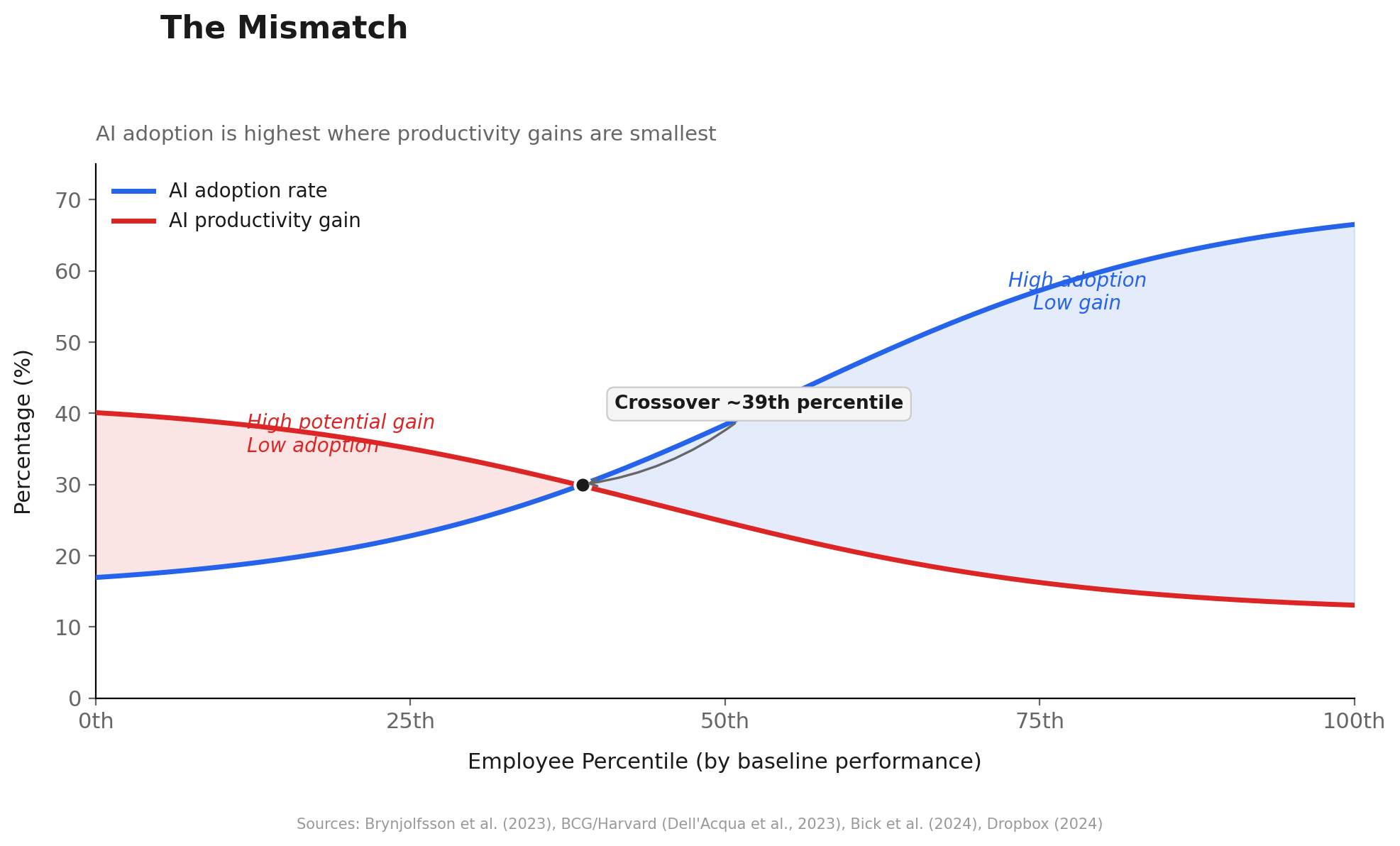
In my teams, the engineers who were already the most productive were the ones experimenting with AI. They were writing the cleanest code, holding the strongest mental models. The junior engineers who would have benefited most? They barely touched the tools.
 Sources: Brynjolfsson, Li & Raymond (2023); Bick, Blandin & Deming (2024)
The research confirms exactly what I saw. Brynjolfsson studied 5,179 customer support agents. Bottom quintile improved 35%. Top quintile? Roughly zero. Bick found a 2:1 education gradient in who actually uses AI. The workers who gain 35% adopt at half the rate of workers who gain close to zero.
Almost perfectly inverted.
The people standing to gain the most from these tools are the ones who aren’t using them, and the people using them the most are the ones who need them least.
This is the thesis that makes everything else click. It’s not just that adoption is low. Adoption and potential gain are inversely correlated.
The integral problem
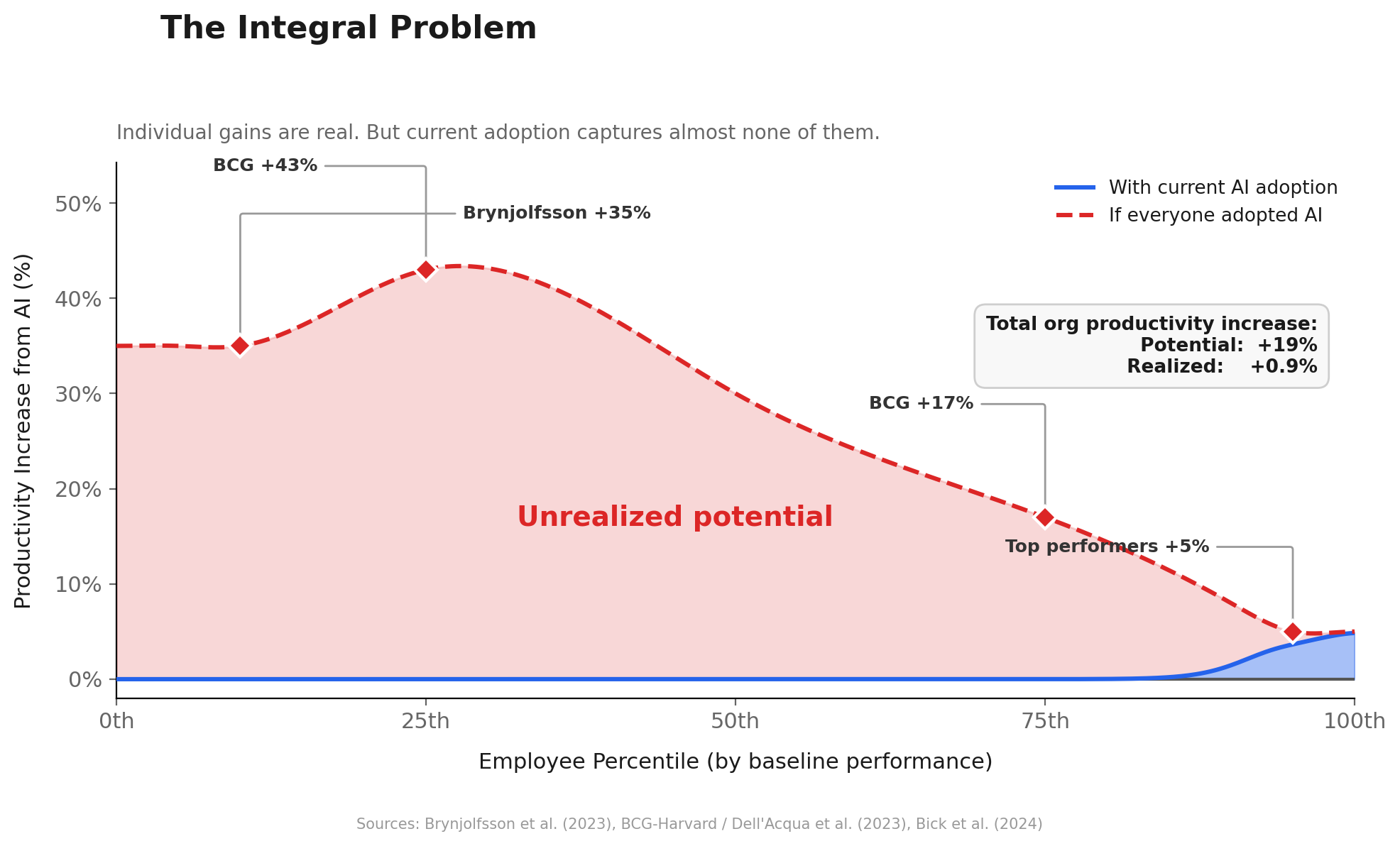
I think about organizational productivity as an integral. The y-axis is each employee’s output. The x-axis is their percentile. The total productivity of the organization is the area under that curve.
 Sources: Brynjolfsson et al. (2023); BCG-Harvard (2023); Bick et al. (2024)
Look at the chart. The red dashed line is what we’d gain if everyone adopted AI. Huge lifts at the bottom, tapering toward the top. The blue line is what we’re actually capturing. Almost nothing. Only the top few percent are using the tools. That red shaded area? All unrealized potential.
Realized Gain(x) = Individual Gain(x) x Adoption Rate(x)
You’re multiplying big numbers by small numbers everywhere. Lab studies find 14-40% individual gains. Penn Wharton measured 0.01 percentage points of aggregate impact. A 1,000x gap. The Anthropic Economic Index found AI usage has a Gini coefficient of 0.84 to 0.86. (That’s more concentrated than income inequality in the most unequal country on Earth.)
Amdahl’s Law
Even among the people who do use AI, the gains disappoint. I spend maybe 10% of my time writing code. (A Microsoft study of 484 developers found the same number.) The rest is meetings, debugging, architecture, code review. All the stuff AI can’t touch yet.
If AI makes coding 3x faster, the theoretical maximum improvement is 15%. Even if coding became instant, the max is 25%. That’s Amdahl’s Law: you can only speed up the fraction of work AI touches.
METR ran the most rigorous test to date. Sixteen experienced developers, randomized to use or not use AI tools on 246 tasks. The AI group was 19% slower. But they believed they’d sped up by 20%.
The organizational multiplier
When 1 in 20 on my team used AI effectively, the other 19 still set the pace. Didn’t matter that my best engineer wrote code twice as fast if the bottleneck was design review or QA or the deployment pipeline.
This is O-Ring theory. Production is multiplicative. One broken link degrades the whole chain. Google’s Project Aristotle confirmed it across 180 teams: how people interact matters more than who’s on the team.
Most organizational work isn’t breakthrough discovery. It’s execution. Delivery. The integral under the full curve determines what ships. Right now, that integral barely moves.
The capability-adoption gap
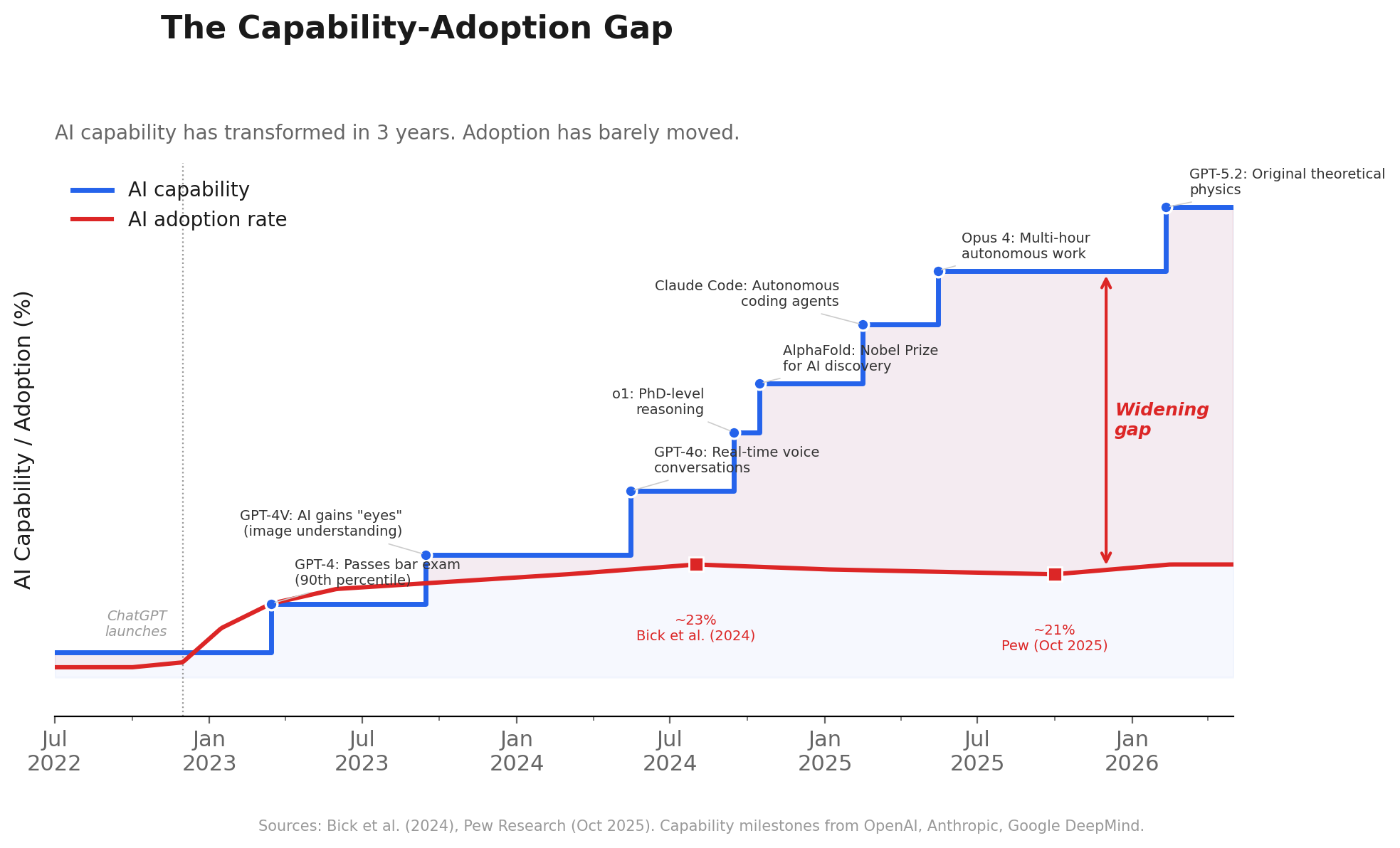
The AI capability curve vs time is practically vertical. The other (organizational productivity) is flat.
 Source: Compiled from public announcements and benchmark data
Look at this chart. March 2023, GPT-4 passes the bar exam. Late 2024, reasoning models hit PhD levels. Early 2025, autonomous coding agents ship. February 2026, GPT-5.2 contributes original physics.
The capability curve is vertical. Adoption? Flat. Lucidworks found 42% of companies abandoned most AI initiatives in 2025 (up from 17% in 2024). Companies aren’t ramping up. They’re giving up.
The exceptions prove the rule. Shopify mandated AI as a baseline expectation. JPMorgan went from banning ChatGPT to deploying LLM Suite to 200,000 employees in eight months. The gap isn’t between companies that have AI and those that don’t. It’s between companies that enabled it broadly and those still running pilots.
Why the gap exists
I’ve watched this up close for over two years. Five problems keep surfacing.
The learning curve is real
Even for me, getting truly productive with AI took real effort. I got lucky. During paternity leave, I had unstructured time to experiment. I’d hold my son in one arm and voice-transcribe prompts with the other. That gave me something almost no working professional gets: hours of low-stakes experimentation.
Most employees get maybe 30 minutes before the next Slack message. That’s not enough. Humlum and Vestergaard confirmed this with 18,000 workers: even when researchers told people AI could halve their task time, it had zero effect on usage. Zero. Information doesn’t drive adoption. Friction does.
The belief deficit
People’s impression of AI comes from two places, both misleading.
Google’s AI Overview told users to eat rocks. GPT-5.2 Pro spent nearly three minutes reasoning about whether to walk or drive to the car wash, explicitly noted that “the wash requires the vehicle to be present,” and still told me to walk.
Then there’s the marketing. Companies spent $8 million per Super Bowl spot. 23% of ads featured AI. Google’s Gemini ad hallucinated a fact about Gouda cheese on national television. Only 32% of Americans trust AI. Can you blame them?
The irony is that the tools that actually work (terminal-based coding agents, agentic workflows) succeed because they target constrained domains where outputs are immediately verifiable. Does the code compile? Does the test pass? But that’s not flashy enough for a Super Bowl ad.
BCG found that leadership support alone swings positive AI sentiment from 15% to 55%. That’s a 40-point swing just from managers taking it seriously.
Corporate training has not evolved
Every AI training I attended was a marketing person demoing integrations nobody asked for, or an executive showing tools employees aren’t allowed to use. The audience nods politely. Nothing changes.
BCG’s data: 5+ hours of training gets you to 79% regular usage vs. 67% with less. Twelve percentage points from actually investing. Real training means capstone projects. Each team builds a workflow for their own use case. Not a slide deck. Not a lunch-and-learn.
Enterprise tools aren’t ready
Companies shove half-baked AI wrappers down employees’ throats. “Use our internal chatbot. It’s approved by security.” You try it. It’s slow. The model is two generations behind. You go back to whatever you were doing before.
Meanwhile, the tools that actually work are blocked. So 78% of AI users bring their own tools. JPMorgan figured this out. They went from banning ChatGPT to deploying LLM Suite to 200,000 employees. Solve compliance at the infrastructure level. Build guardrails, not gates.
Productivity is deeply personal
The way I write code is different from how you write code. There is no single AI workflow that fits everyone. Enterprise tools pretend otherwise.
The Anthropic Gini data (0.84-0.86) isn’t measuring adoption rate. It’s measuring how personal productivity is. Power users invested time to build workflows for their specific work. You can’t copy-paste that across a thousand people. BCG’s “silicon ceiling” data backs this up: frontline adoption stalled at 51% in 2023 and hasn’t moved since.
The agentic interface
AI is in its pre-browser moment. In the early 1990s, the internet was extraordinary. But using it meant memorizing terminal commands and configuring network settings manually. Then the browser shipped. The technology didn’t change. The interface did.
The most powerful AI tooling today lives in the terminal. Claude Code, Codex CLI, Aider. That’s structural. CLI tools have full access to your machine: read files, write code, run tests, chain tools together. You can’t do that from a chat window.
Two years ago, I ran a customer outreach program at a large tech company. Slow, imprecise, generic messages. Today, with agentic tools, the same campaign can be surgical. Pull data from a CSV. Look up contacts through browser automation. Draft tailored emails. Send through authenticated APIs. All from one interface. But it took real effort to build.
Claude Code crossed $1 billion in annualized revenue faster than ChatGPT. Cursor hit $1 billion ARR. Developers aren’t waiting for enterprise tooling. They’re building their own workflows now.
What to do Monday morning
Mandate the AI path, with patience
Default to the AI-assisted approach for new projects. But budget for a temporary productivity dip. You can’t mandate AI and penalize people for being slower while they learn.
Invest in applied training, not demos
Stop demo-driven training. Each team builds a tool for their own use case, with coaching from AI-fluent colleagues. I became fluent during paternity leave because I had unstructured time. Create that expectation: if it can be done with AI, do it with AI.
Embrace agentic interfaces
The productivity unlock isn’t the enterprise chat wrapper. It’s tools that integrate into real workflows. Pulling data, automating actions, chaining operations. Give teams budget and permission to explore them.
Accept that productivity is personal
Stop prescribing one-size-fits-all. Give people time and permission to find their own use cases. The goal is to move the whole distribution rightward, not force everyone through the same door.
Enable, don’t gate
Stop battling shadow AI. You will lose. If 78% of users bring their own tools, the problem is your approved tools. Solve security at the platform level. Trust your employees.
The bottom line
The gap between AI capability and AI impact is organizational, not technological. The mismatch means the people who’d benefit most aren’t using the tools. Amdahl’s Law means even among those who do, the gains are bounded. The integral barely moves.
Nearly 90% of 6,000 executives in the NBER study said AI has had no impact on productivity. Yet they forecast 1.4% growth over the next three years. The belief is there. The results aren’t. That’s the Solow paradox, playing out again.
The integral only changes when the whole curve moves. Not just the tail.